

what's your core?
What happens when identity becomes a subscription service.

Have you bought Hailey Bieber’s granny pumps yet? No? Didn’t you get the memo that we are all cosplaying grandmothers this month? Grandma core is all the rage now. Oh, you haven’t moved past poet core? What about mob-wife core? Pirate core? Thot daughter? Barbie core? Dark academia? Cottage core? Office siren? Coquette? Fairy core? Witchcore? Errand core?
According to Fandom.com’s Aesthetic Wiki, the internet has already explored 210+ new aesthetics since 2020. That checks out, considering that the average lifespan of a 2026 TikTok micro trend is about three weeks. And what happens each time a new trend goes viral on TikTok?
One week in, news outlets, including legacy media like Vogue, churn out SEO articles “breaking down” the trend. Your neighbourhood it-girl influencer posts a tutorial on the “essentials” required to style the trend with carefully curated affiliate links.
Two weeks in, normal folks are trying it out. The trend surfaces in everyday conversations. You buy some of the “essentials” to give it a try.
Three weeks in, brands and celebrities catch up. Now the trend is everywhere. It isn’t chic anymore. The trend has met its end. It is now mainstream nonsense. Cringe. Unoriginal. Tasteless. The TikTok commentators have caught up to the trend. They are now dissecting the social issues that manifest through the trend.
Four weeks in, your favourite Substack essayist writes an article on how the trend is problematic, summing up the ten most popular commentary videos, but more eloquently than them. The “essentials” you bought for the trend go to the back of a wardrobe that doesn’t reflect your fashion identity or personal style.
In this issue of girl online, I argue that your core personality should be more than a Pinterest moodboard that doesn’t stay in the zeitgeist for even a month. Pretty obvious, right? Apparently not.
girl online is a reader-supported publication on the evolution of digital girlhood. If you’re a regular here (I love you!), consider buying me a coffee to help me keep all issues free to read.
Every time I go on TikTok, I am in awe. Each refresh of my For You page reflects my true self. My struggles and current problems. My dreams and aspirations. Wow, the girlies there really get me. And every time I think so, I have to remind myself that I am not really being understood. Rather, a highly efficient algorithm that has been fed more information on me than my conscious self knows — search history, spending patterns, demographics, psychological triggers, and whatnot — is pre-packaging that information into feeding me content that will keep me scrolling for hours, so my attention and impulsivity can be sold in bulk to the highest bidding advertiser.
And when you apply this algorithmic process to a whole demographic rather than a person, you get a micro trend. Our collective algorithm takes a deep, human desire and instantly forces it into a rigid, searchable taxonomy.
The girls craving for higher education, classical literature, and spending time with the arts in a world that gate-keeps liberal arts education gets served up dark academia. The girls craving for a slow, rich life in the country in a culture that romanticises working to death can just cosplay cottagecore. The girls tired of the divine feminine and tradwives, who want to be seen as tough, while still being fashionably feminine, and taken care of by an imaginary man, are the mob-wives. That is, you don’t really need to spend your generational wealth to major in philosophy anymore. You need the tortoiseshell glasses, the vintage tweed blazer, the specific sepia-toned filter, and the curated Spotify playlist of melancholic cello music.
Historically, subcultures were born out of lived experience and material realities. For instance, the punk movement wasn’t just safety pins and leather jackets. It was a visceral, political reaction to economic stagnation, class warfare, and a rejection of the status quo. To dress like a punk meant you participated in the scene, shared the politics, and felt the anger.
Figuring out who you are is an incredibly inefficient, high-friction process. It requires time, money you can’t afford to waste, but you still invested in a side-quest, arguing with your parents that they just don’t get you, crying on the bedroom floor at 3 A.M, and sometimes looking stupid in front of everyone. That process was a natural filter. By the end of it, the things that stuck around were the things you genuinely cared about, and the painful process of getting there became a part of your identity.
My problem with the trend cycle is that it removes the friction that catalyses real identity formation. So we no longer have to do the heavy, agonising work of discovering who we are. We just need to spend more money to feel alive for a moment before we hop onto the next trend. And the subscription economy is here to help us live our trend-grifter lifestyle efficiently.
When capitalist markets spot a hyper-accelerated consumer need, they productize it. If we have to keep up with the trend cycle, we don’t have the luxury of owning things. Sure, fast fashion is a solution to ease the cost of keeping up. But the climate-conscious girls need to have fun too. Enter: clothing rentals and peer-to-peer fashion economy.
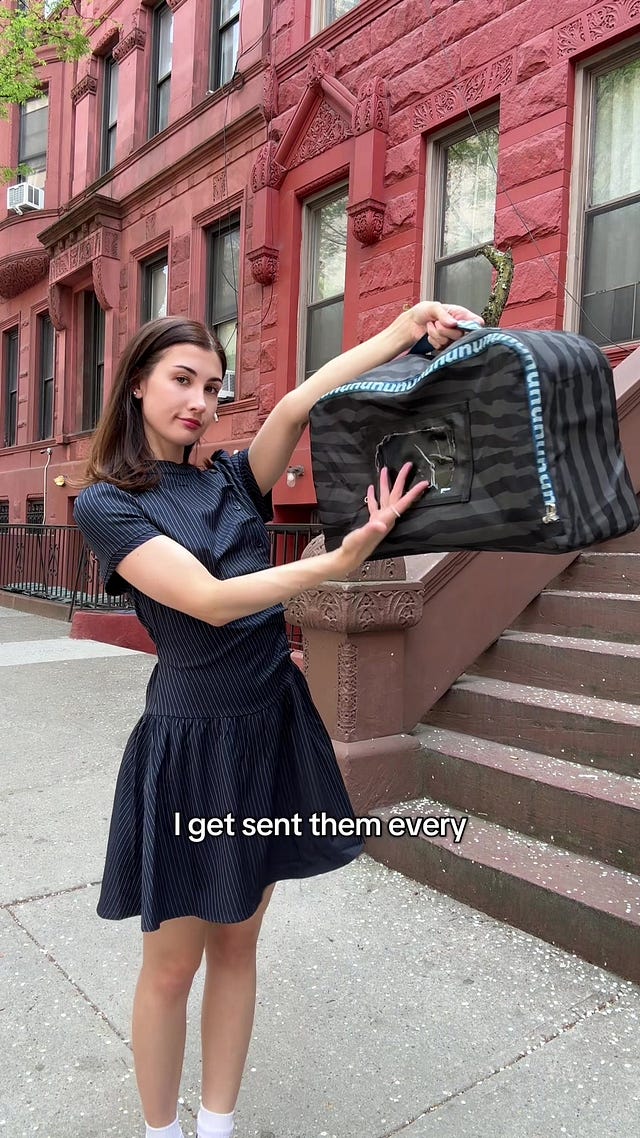
 Tiktok failed to load.
Enable 3rd party cookies or use another browser
Platforms like Nuuly, Pickle, Flyrobe, and others have essentially turned your wardrobe into a revolving door. Who cares about building a collection of quality pieces that reflect your enduring personal taste and you will use for decades, when you can subscribe to a rotating carousel of aesthetics? Need to look like a corporate woman with a mysterious, sultry edge for the grid? Rent a turtleneck and a pencil skirt! Done with that vibe? Ship it back in a pre-paid mailer and swap it for cable-knit sweaters and linen trousers to match the coastal grandmothers taking over the feed. We no longer need to commit to a style or hobby, because everything we use to signal who we are is designed to be returned.
P.S: This is not to say peer-to-peer lending apps have no use case. Later in this issue, we discuss an excellent benefit of them.
Now, we can blame this on social media vanity and the desperation for attention. But the truth is more complicated. Most of us are not performing for an audience. We are performing for ourselves or the people in our heads, as I like to call it.
In a world that feels increasingly fragmented, unstable, and overwhelming, we use these pre-packaged cores as a coping mechanism. A form of self-gaslighting via consumerism, if you will. We use the visual signifiers of a lifestyle to convince ourselves that we possess the virtues attached to it. If my desk looks like a thot daughter mood board, then surely I am a deep, contemplative thinker even if I’ve spent the last four hours hate-watching Candace Owens. We become the primary audience for our own illusions, and the aesthetic in itself becomes a shortcut to a borrowed self, allowing us to bypass the slow, difficult process of actually building our own core.
The problem is that human beings need a cohesive narrative arc to feel mentally stable. We need to feel like the person we were five years ago is connected to the person we are today through a logical chain of growth, experience, and memory. But when you swap your core every three weeks, your personal history becomes a series of disjointed, superficial chapters that don’t add up to anything. You look back at your digital footprint from six months ago and feel no emotional connection to that person because that person was just a rented costume. You become a stranger to yourself, suffering from a sort of cultural amnesia where you can no longer trace your own genuine evolution.
That brings me to my titular question: What’s your core?
No, I am not talking about that one Twitter (now, X) trend where users were sharing Pinterest results for the search term “y/n core.” I am asking if you chip away everything that the Big Tech algorithms have told you you are, what exists as the core of your personality? If you are a Gen Z, it is a very difficult question because we were exposed to the internet way before we formed the initial impressions of ourselves, but with a little bit of conscious effort, I am positive that we can find traits that truly define our personality and forge an identity that doesn’t go around with the trend cycle.
A concept that I would like us to apply in finding our cores is the Lindy effect. The Lindy effect states that the future life expectancy of something is proportional to its current age. For example, Shakespeare’s plays have been performed for over 400 years now. So they will likely be performed for another 400 years.
To apply the Lindy effect to our lives, we need to go back to our childhood. What were the things you were obsessed with before you laid your hands on a screen?
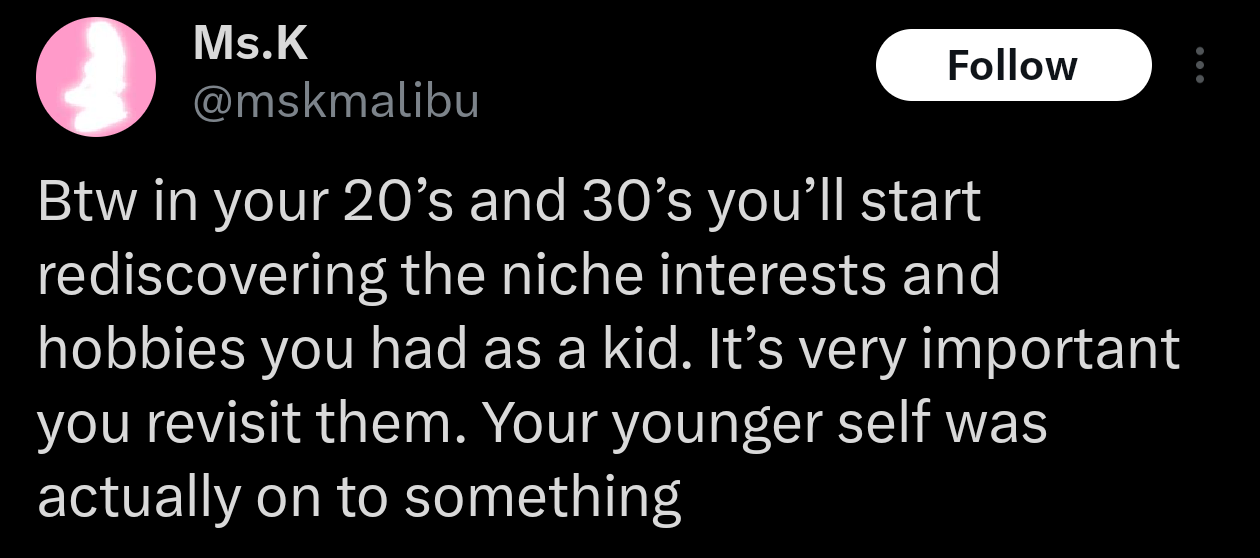
I got my first laptop at 10. Before that, I was obsessed with Egypt and the mummies, detective stories (shoutout to Nancy Drew and Enid Blyton books), space and stars, and junk jewellery (I love earrings and rings). I am sure you also have a few interests that you “grew out of.” Maybe you have. Maybe revisiting them is worth a try.
Similarly, what are the non-negotiable items in your wardrobe? Not the impulse buys. The dress you wear to every single first date. The three pairs of workout leggings you alternate between. The pair of jeans you squeeze the life out of despite the horrendous thigh rub tear. That's your style. So on and so forth, by applying the lens of the Lindy effect to various aspects of your life, we can identify at least a skeleton of our cores.
Now this isn't to say you don't ever experiment with your style. Experimentation and exploration are the keys to self-evolution. And this is where peer-to-peer clothing rentals become highly relevant. Renting a few pieces of clothing to try on to see if it has a space in your core wardrobe, once in a while, can be a fulfilling exercise. Even better, if you have a small group of friends with whom you can exchange a few pieces to see if those styles are your thing.
Some people have a higher proclivity to experimentation than others. Only you know your base rate of experimentation. But mindfulness needs to be exercised to ensure experimentation doesn't slide into yet another dance with the trend cycle.
In conclusion, your core isn’t something you need to buy a subscription to maintain, and it’s definitely not waiting for you on a For You Page.
As a teenager we even knew about this (my bestie and I) and we used to just simply call them "phases" haha.
In the 90s/2000s we called these things subcultures they involved actually doing things not just consumption however. Anyway while there are tweaks here & there most of my basic tastes & interests are similar to what they were in high school. More in depth and broader in diff ways. Hippie, art noveau, mythic, fantasy, medieval, Romantic. Folk art from around the world.