

when pervert glasses surveil protest grounds
Girl boss influencers selling the Ray-Ban Meta AI glasses as an aesthetic choice are lying to you. Here's the ground reality from India.

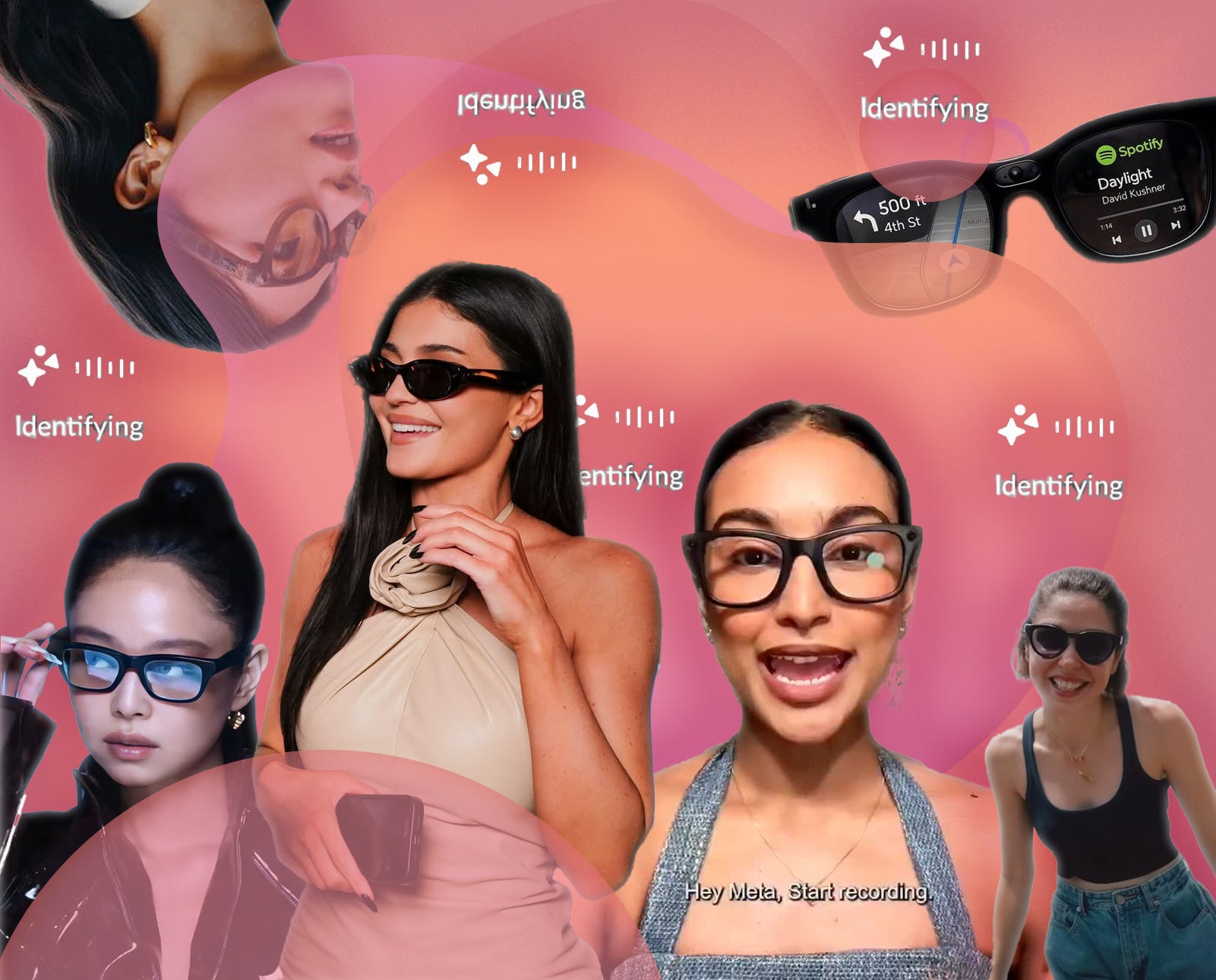
When I was a really young girl, I used to often daydream about a technology that could record everything I saw and replay it. The reason is going to sound quite sympathetic. My mom used to go back on her word quite a lot. She would allow me to do something in private, and when someone else criticised her, she would say she knew nothing about it. For instance, she would let me wear a sleeveless top, and when my grandmother critiqued the immodesty of the outfit, my mother would blame me, saying I don’t listen to her.
But by the time the first generation of the Ray-Ban Meta smart glasses released in September 2021, I had grown up to understand the intricacies of surveillance capitalism and learned to value my privacy and be mindful of my digital footprint. So much so that later that year, I deleted an Instagram account with a following of over 5000 that I had worked hard on. The idea of people having access to my 20-year-old self’s unedited thoughts and human evolution didn’t sit right with me. This is also partly the reason why I haven’t started an Instagram page for girl online, even thougjh the audience on short-form video platforms will be able to relate to the kind of stuff I talk about.
All this is to say that my sense of privacy is more than the average person, and that the idea of a technology that passively records everything my eyes can capture doesn’t sit well with me. But you don’t even have to be a privacy nerd like me to gauge why something like the Ray-Ban Meta AI glasses is bad news for everyone, especially women.
Unfortunately though, many of India’s feminist, girl boss influencers are either too naive to understand the obvious harm this kind of technology can perpetuate or don’t care about the people they build their entire careers on to say no to a fat pay check.
Here’s some context before I go about the rest of angry-woman rant.
In June 2026, Meta released the third generation of it smart glasses in partnership with Ray-Ban, and to promote it, they partnered with many influencers and celebrities from around the world. You are probably aware of Kylie Jenner and Jennie of Black Pink being called out for their endorsements. While this issue of girl online, will touch upon the global implications of this technology, I will be focusing mostly on what is happening in the India with respect to these glasses.
I could care less about celebrities like the Jenners endorsing this product. It is easy for me to write them off as standard billionaire greed. They inhabit a world so removed from public transit and crowded street markets that the implications of the hardware must barely register.
I am more uncomfortable when Komal Pandey, Rida Tharana, Sakshi Shivdasani or Naina Bhan — influencers whose content and communities revolve around emotional intimacy, female solidarity, and relatable everyday life — promote them. Because when they promote these glasses, they aren't just selling a cool technology, a travel partner, or a way to archive our favourite memories, as Meta is marketing them. They are co-opting the language of female kinship and feminist rhetoric to sanitise what is essentially a body-worn surveillance device.
Now there is a reason Meta wants to position these glasses as a cool, lifestyle choice rather than a product of cutting-edge (surveillance) technology. They have learned from the failure of the Google Glass.
The Google Glass launched in 2013 looked industrial, alienating, and overtly cyborg-like, and the wearers, mostly tech nerds were immediately recognised as privacy threats and dubbed “Glassholes.” The Google Glass looked distinct from everyday eyewear, but the surveillance aspect was the primary concern back then, as well.
In TikTok language, Google Glass crawled, so Meta’s could run. If the primary audience of Google Glass was tech bros, for Meta, it is you, me, and our girl gang.
Meta is selling their smart glasses as a digital diary — a way to stay in the moment while recording your favourite memories. And the pitch is simple: Capture your life as you see it. What these influencers conveniently claim to not understand is that public space is not a private diary. The moment you step outside wearing a camera at eye level, your authentic POV requires capturing hundreds of unsuspecting bystanders.
When an influencer pulls out their smartphone or sets up a tripod, it sends a social cue. People around them notice the lens, evaluate their comfort level, and can step away or adjust. Smart glasses intentionally destroy that social boundary. By wrapping surveillance in girl boss aesthetic and disability advocacy, these creators are doing Meta’s heavy lifting — teaching young women to view a passive data-harvesting tool as nothing more than a cute fashion upgrade.
girl online is a reader-supported publication on what women are doing on the internet and what the internet is doing to them. If you’re a regular around here (I love you!), consider buying me a coffee and help me keep all future issues free to read.
And while Meta wants you to look at their “pervert glasses” as an aesthetic choice, marginalised communities from around the world are reporting the harm the wearers are perpetuating on them.
For instance, a few months ago at a trans rights rally in New Delhi, India, protesting the Transgender Persons (Protection of Rights) Amendment Act 2026, Shubnam, a transfeminine person who uses they/them pronouns, was recorded without consent by a content creator named Parley (@parley.96) using the Ray-Ban Meta smart glasses.
Article 14 reports on the incident:
“Within hours, Instagram’s algorithm propelled Parley’s post, triggering a wave of transphobic abuse and AI-generated memes (here, here, here and here), including AI-generated images likening Shubnam to a Hindi animated cartoon named ‘Ganji Chudail’ or bald witch. Copies of the video migrated to X and YouTube, where it remained available for weeks despite repeated complaints.
A video of the fleeting exchange where Shubnam told Parley to “f*** off” after sensing they were being recorded spread across the internet, making them fodder for online trolls. As Instagram’s algorithm catapulted the video, it brought Parley notoriety through millions of views and thousands of comments.
India has almost no legal or regulatory framework governing AI wearables, such as Meta’s smart glasses, which it is pushing in one of its fastest-growing markets, raising questions about privacy, consent, surveillance and even the right to protest. Shubnam’s experience illustrates how powerful AI systems embedded in wearable tech can enable tech-facilitated violence against vulnerable groups.
The threat of surveillance of marginalised people, however, extends far beyond clout-chasing influencers. The normalisation of smart glasses in everyday fashion has now provided perfect cover for a much more dangerous actor: the surveillance state. In a country like India (ranked 157th out of 180 countries in the 2026 World Press Freedom Index released by Reporters Without Borders), it is the newest weapon in the state’s arsenal.
During the recent peaceful student protests at Jantar Mantar against the NEET exam paper leak (the centralised entrance test for admission to medical schools), the Delhi Police personnel were spotted wearing AI smart glasses while monitoring the crowds. Later, after the protestors disbanded, reports suggest that many of these students were rounded up from their hostels and homes using facial recognition technology anf centralised databases.
Meta’s primary defence against accusations of covert recording rests almost entirely on a single feature: a tiny, white LED light mounted on the frame that illuminates when the camera is active. This “privacy light” is a joke. In a dimly lit room, it might catch someone’s eye. But outside in the streets of Delhi or inside a dimly lit nightclub, a micro-LED is virtually imperceptible. More critically, as tech journalists demonstrated within days of the product’s release, the LED light can be rendered useless with a millimetre of black electrical tape or a dab of nail polish. And if those aren’t working, for as little as $60, hackers all over the world can disable it for you.
The reality is that with Ray-Ban Meta AI glasses, anybody can doxx anyone. In late 2024, two student researchers from Harvard University made headlines for their demonstration project called I-XRAY. By pairing Ray-Ban Meta glasses with public facial recognition software and automated web-scraping LLMs, they created a real-time doxxing engine. That is, a wearer could simply look at a stranger on the subway or on a university campus, and within seconds, their phone screen would display the stranger's full name, home address, phone number, and names of family members.
Recording strangers and doxxing them is just the tip of the iceberg. Meta's Terms of Service reserves the right to send users' interactions with its AI services, including its always-on live AI features, to human moderators. An investigation by Swedish outlet Svenska Dagbladet published earlier this month reveals what happens to these videos and who these human moderators are. The report found that Meta workers in Kenya were asked to analyse intimate and often disturbing footage from videos taken via these glasses by wearers around the world as part of their data labelling process. The workers review and annotate the footage taken in bathrooms, featuring nudity and sexual content, and images showing personal information like bank accounts, so when their AI models are trained on this data, the AI can understand what it’s processing.
All this Being said, the ability to record my entire life hands-free isn’t empowering to me. The right to exist in public without having my face captured, monetised, and shipped out to data-labelling factories in the global south is. This is precisely why the complicity of creators like Rida Tharana, Sakshi Shivdasani, and Naina Bhan is so difficult to swallow. These influencers built their platforms on relatable vulnerability and the unspoken pact of sisterhood. They sell an image of community to millions of young women who look up to them to navigate a culture that is already deeply hostile to female autonomy.
You cannot claim to be a girl’s girl while promoting a technology that enables profiling of marginalised people at protest grounds and strips away the basic autonomy of every woman on the street. You cannot talk about creating safe spaces online while normalising the technology that dismantles safe spaces offline.
Meta knew what they were doing when they handed these glasses to lifestyle creators and celebrities instead of tech bros. They needed “our girl gang” to hide the fact that they are distributing body-worn surveillance apparatuses to the masses behind feminist rhetoric and aesthetic get-ready-with-me videos.
In conclusion, the Ray-Ban Meta AI glasses are not a trendy travel partner, an innocent digital diary, or a chic fashion upgrade. They are mobile nodes in a global surveillance network, and no amount of curated unboxing or aesthetic hot-girl walks will ever change that reality.