

inside the predatory world of spiritual tech
Why your astrology app wants you to stay anxious.


Back in December, while I was going through an intense quarter-life crisis, I came across an advertisement for tarot readers and astrologers to join the spiritual tech platform Nebula. The ad was talking about how Indian astrologers on their platform can set their own working hours and are earning in dollars. Now, I have used Nebula in the past and was curious to know how things happened in the backend. But what I found out about them was, let’s say, questionable.
I sent in an “application,” and they emailed me an AI-generated test which didn’t test anything more than my basic knowledge of what each card meant. After that, I had to do a reading for Emily, who I assume was also AI. I was already turned off, but I had a work deadline fastly approaching, and I had already exhausted all other avenues of procrastination, so I went on with it.
After successfully answering when my AI interviewer would get a job, I was officially selected to be one of the psychics on the platform. They sent over a contract and login credentials to access their internal training platform. The pay was going to be a whopping 30 cents/minute. That is, if the client wasn’t a new user taking advantage of their promotional free chats. In that case, I would be paid nothing.
The training material established some ground rules:
You need to set your hours for the day at least 2 days prior and honour them. Fair enough.
You can’t contact a user outside of the app or share your personal details with them. Also fair. Anti-competition and whatnot.
Within 24 hours of a reading with a user, the app will automatically send an update about the situation and invite the user to rejoin the chat. You shouldn’t tell them that this is an AI-generated message. Hm, isn’t that a little unethical? It is, dear reader. But ethics don’t make money. Preying on people’s anxieties so that they keep recharging their wallet to access more minutes with a psychic will.
If you are a 20-something-year-old, you are most probably familiar with astrology apps — Co-star, Nebula, AstroTalk, AstroSage, AstroYogi, etc. You may be a regular user of one of these. Or you may have come across their marketing content and have just tried out the free chat for first-time users. Or you know someone who has tried them out. But they are part of your vocabulary.
One of my girlfriends is such an active user that AstroYogi is a line item in her monthly budget. She first started using them while navigating a break-up with her then-partner of three years, but it quickly became a habit. So adding it to the budget was the only way she could control the money she spent on these platforms during her frequent 3 AM spirals.
Prashant, a 24-year-old Product Manager based in Bangalore, India, first downloaded AstroTalk in the final year of his bachelor’s degree. After three months of futile job searching, he was stressed and anxious. “I was doing everything I could; still, I wasn’t getting results. Then I came across AstroTalk’s advertisements on Instagram, and I wanted to know what it had to say,” he opens up. “I talked to a lot of astrologers, but all of them gave me positive but different answers, which really freaked me out.”
Arushi Shrivastav, an astrologer and tarot reader who has been reading on various apps for the past five years and is currently reading on AstroTalk, explains the rationale behind the overwhelmingly positive answers you get from these astrologers: “People sometimes want to hear what they want to hear. They are looking for someone to reassure them. They just want a ‘yes.’ Also, if you can provide the reassurance they are looking for, they keep coming back asking questions like ‘You said this would happen, it didn’t. Why?’”
Kalyani*, an astrologer who primarily reads on AstroYogi, adds, ”Sometimes when a client badgers me after providing a negative response, I give up and agree with them. Otherwise, they leave negative reviews. That affects my ratings, discoverability, and my rate per minute.”
Skye*, a reader based in Seattle, US, tells me that working on Nebula is easy as long as you are ready to please the clients. “They say that you can make up to $1500/month. That’s a lie. On a good month, I make about $500 dollars. It’s not a bad side hustle,” she adds.
Saying whatever the client wants to hear just to keep them coming back to the app might seem unethical to us; but these astrologers are trying their best to survive at a workspace that commodifies spiritual reassurance into gamified dopamine. While the recruiting advertisements talk about “owning your own hours” and “earning in dollars,” the reality couldn’t be farther from that.
For instance, an average astrologer on Nebula is listed as $3.99/minute. In reality, the astrologer takes home just about 30 cents/minute before taxes and the charges levied by payment gateways. Nebula also requires a psychic to be online at least 20 hours a week. And every 15 minutes when you are not speaking to a client, you need to hit an “I am still here” alarm to prove that you are online.
Closer home in India, astrologers get about 30% of what the users pay to access them. The listed fee of an AstroTalk astrologer I spoke to is ₹17 (~18 cents) per minute, but she actually makes only ₹6 (~6 cents) every minute she talks to a user. She is also contractually required to be online for at least 6 hours every day. Every three months, based on her performance, they increase her per-minute price on the platform by ₹5, and she can keep ₹1 from that increment.
And as I already mentioned above, readers do not make any money on the promotional free chats. During heavy promotional periods, Kalyani spends close to 2 hours daily servicing these unpaid clients because her manager encourages her to do so, saying that it is easier to build an ongoing relationship with a new user who hasn’t spoken to anyone else on the platform. A stay-at-home mom with no other skills to monetise, Kalyani says she still does it because this is the only opportunity for her to better her living conditions.
girl online is a reader-supported publication on what women are doing on the internet and what the internet is doing to them. If you’re a regular around here (I love you!), consider buying me a coffee and help me keep all future issues free to read.
The precarity of the workers is only half the equation. The real danger of this economic model is what happens when you combine underpaid, heavily managed gig workers with a generation navigating previously unseen levels of loneliness and uncertainty. By lowering the friction to access reassurance to less than that of a cup of coffee, astrology apps have accidentally engineered the world’s most unregulated, untrained, and underpaid emotional crisis hotlines.
Post-midnight, when our collective existential panic peaks, these chatboxes morph from simple divination guidance into confessionals and therapy couches. “When I am doing night sessions, most people just wanna talk. I am just a stranger they can tell their stories to,” Arushi tells me.
Sometimes, what lands in the chatbox goes far beyond casual venting. Arushi recalls a night when a terrified 16-year-old girl who was being abused by her cousin reached out to her. She couldn’t trust anyone in her family and wanted advice on how she could stop the abuse. She believed that her birth chart had insights on why she was being sexually abused. “I did my best to comfort her and reassure her that what was happening to her wasn’t her fault and to look for a trusted adult,” Arushi tells me.
To understand why a teenager who has no emotional support or a 23-year-old navigating heartbreak defaults to AstroTalk at 2 AM instead of a professional counsellor, we need to first understand the massive systemic barriers in traditional healthcare.
Mehr Lungani, a psychotherapist and founder of Chaos to Cosmos, who also reads tarot, says: “Therapy can feel expensive, intimidating, time-intensive, and emotionally confronting. In comparison, tarot and astrology apps are affordable, immediate, available 24/7, and often packaged as comfort. You can open an app at 2 AM after a breakup and get an instant answer... That immediacy is psychologically very powerful.”
This immediacy, or time, is the number-one metric these apps engineer to keep users in the loop. For instance, on AstroYogi, readers need to share their first insights within 11 seconds of a user joining the chat. Reassurance can’t be provided that fast anywhere except for maybe on an AI chatbot.
Now take this need for reassurance, gamify it, and make the barrier to entry as low as possible. That’s astrology apps for you. The biggest players in the market — Co-star, The Pattern, AstoTalk — are all venture-backed startups. Keeping you anxious and constantly second-guessing yourself is the business model.
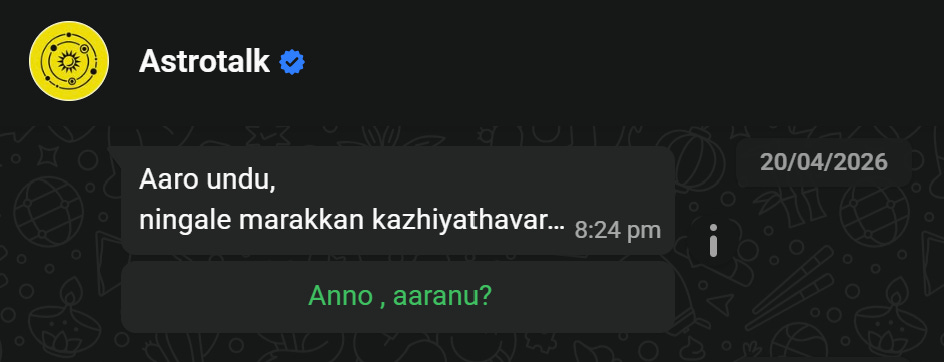
The onboarding rules Nebula handed me about the app automatically texting a user 24 hours after a reading, pretending to be a personal update from the psychic, isn’t a one-off tactic. It is an industry-wide practice. Basically, the algorithm senses an emotional vulnerability and sends trigger notifications to incite just enough curiosity to trap users in a cycle of compulsive checking.
Meghna*, a 35-year-old photographer based in Gurgaon, India, tells me, “Sometimes I ask the same question to many astrologers until I get the answer I want. I am a very anxious person; some nights I can’t sleep without knowing that everything will work out.” She tells me that the concerns are different on different days. A client that hasn’t processed the invoice, a project she isn’t confident about, a man who she is seeing casually, but the result is the same: She spends more than she should on these apps overnight and feels guilty about wasting money the next day.
We human beings are naturally wired to seek reassurance, especially during painful moments. But reassurance, even when consumed compulsively, only offers temporary relief. The anxiety usually returns stronger, which then creates the need to seek more reassurance again. That loop can become addictive.
This is the ultimate triumph of the reassurance economy. It extracts capital from the very confusion it creates. The user is anxious, so they buy minutes. The astrologer is pressured by timers and ratings, so they provide cheap, toxic positivity. The conflicting or vague answers make the user more anxious, so they log back on at 3 AM to find a second opinion. The cycle repeats, the clock ticks, and the platform takes its 70% cut.
Divination, at its historical best, has functioned as a slow, relational human science. It is a symbolic, nuance-heavy language meant to help people sit with ambiguity, timing, contradiction, and deep self-reflection. But venture-capital-backed tech stacks don’t care about our souls, and they certainly don’t care about self-growth. They care about retention metrics, engagement loops, and scaling infinitely.
To understand the allure of divination tech, we just need to look at the world around us. The reassurance economy exists because the world is confusing us: traditional institutions are failing, the job market feels like a lottery, AI is being forced down our throats, dating is a meat market, and mental health care is a luxury. So when life feels out of control, people paying twenty rupees a minute for a stranger to tell them that everything is going to be okay shouldn’t come as a surprise.
We aren’t turning to these platforms because we suddenly believe in the absolute determinism of the stars. We are just looking for a sliver of hope to keep going. But the ghost in the machine isn’t saving us. It’s just feeding our panic back to us while profiting off of the uncertainty they themselves create.
Now, I don’t really have the perfect answer on how to navigate life when it feels like everything is crumbling around you. All I know is that constant reassurance is not the antidote to anxiety. Sometimes we just need to accept that we don’t know what is going to happen and that is okay.