

clout-as-a-service
What happens when "experiences" evolve from physical presence to virtual tags.

“Everyone wants to look like they’re always out — at concerts, cafes, trips — even when they’re not. I thought, what if we actually made that possible?” the 20-something owner of the Instagram handle, @_flex for you_ tells me as we sit down to discuss a digital phenomenon that I have been living rent-free in my brain since January 2025.
Flex For You is essentially a small business that has capitalised on the biggest zillennial emotion, FOMO (fear of missing out). They sell a single product — story tags. For as low as ₹89 (or 95 cents), you can get your personal Instagram handle tagged on vague-enough videos and photos that look like you are out — at an expensive cafe with a date, at a concert everyone is dying to attend, or with your family on an international vacation — even when you're rotting in your one-bedroom apartment, wondering how you'll afford next month’s rent.
For context, Flex For You is just one of the hundreds of tag-for-hire businesses in India that popped up after Get Your Flex (another similar page) went viral for providing story tags from Diljit Dosanjh’s Dil-Luminati India Tour, whose tickets retailed between ₹4999 and ₹60,000 (50x to 600x costlier than the tag, FYI). But this phenomenon is not limited to the subcontinent; clout-as-a-service businesses are popular in the US and China, too.
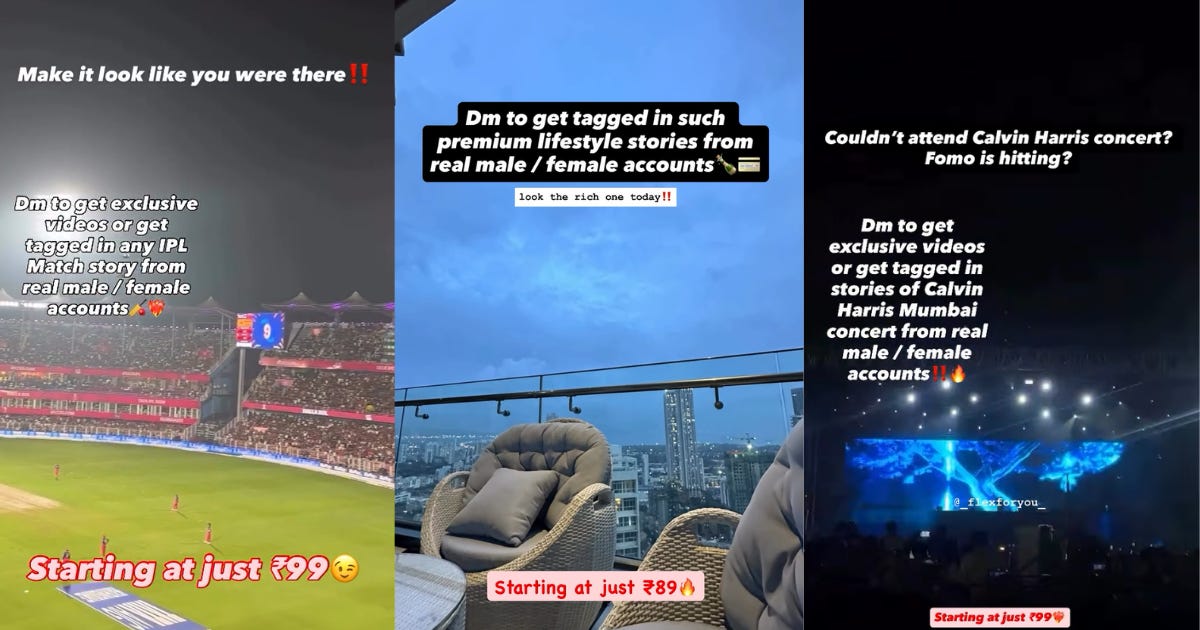
“People want to look active, social, and cool as it boosts presence and status online. Not everyone can attend every event or travel every weekend, but everyone wants that lifestyle vibe on their profile,” the founder of Flex For You (who would like to stay anonymous) tells me. “We just help them achieve that instantly and affordably.”
Is it that simple? Are tag-for-hire services just a harmless trend that helps users look popular? Or are they weaponising young folks’ FOMO to make a quick buck while making social media even more of a hellscape?
In this issue of girl online, we explore the evolution of fake flexing services and why even normal folks with private Instagrams are chasing clout.
girl online is a reader-supported publication reporting on the evolution of digital girlhood. If you’re a regular here (I love you!), consider buying me a coffee to help me keep all issues free to read.
To answer these questions, we need to understand the origins of fake flexing
For that, let’s go back to 2017, the era of the private jet studios. If you are old enough to remember: Hi bestie, how is the quarter-life crisis coming along?
If not, here is an excerpt from what The Independent reported in November 2017:
A company in Moscow is renting out a grounded private jet as a photography studio for aspiring travel “influencers” to pretend they’re living the luxury lifestyle they’ve always dreamed of.
Private Jet Studio hires out the private plane, a Gulfstream G650, for two-hour shoots which cost 14,000 roubles (£185) with a professional photographer thrown in or 11,000 roubles (£145) without. There’s also the option to hire a videographer for £330. The photoshoot package can include professional hair and make-up beforehand for those that want to look their best, too.
Following Moscow, private jet studios cropped up in most major global cities, helping influencers flex their fake journeys on private jets to an unsuspecting audience. In September 2020, Twitter (now X) handle @maisonmellisa exposed this trend, sharing pictures of a set in LA frequented by many rising new media celebrities at the time with the caption, “I just found out LA [Instagram] girlies are using studio sets that look like private jets for their Instagram pics. It’s crazy that anything you’re looking at could be fake. The setting, the clothes, the body... idk it just kind of shakes my reality a bit lol.”
That was the beginning of the end of private jet photoshoots. Later in 2022, the call-out of climate impact caused by celebrities’ private jet culture sealed the deal.
FYI, the 2017 wave of fake flexing wasn’t limited to private jet photoshoots. It also included posing with luxury cars, bikes, watches, bags, and accessories. But as the audience caught up to the ingenuity of these photos, along with the rise of quiet luxury, this kind of obnoxious flexing of perceived wealth to cultivate social status and popularity slowly died out.
And by 2024, we had all decided that “doing things” is much more valuable than “owning things.” Suddenly, attending concerts, eating organic, and travelling internationally became the gold standard of a successful life. And as the popular understanding of the performance of luxury evolved, so did the fake flexing industry.
Social proofing with borrowed clout is not a new phenomenon. The global $30+ billion influencer marketing industry is also based on the value of borrowed clout to enhance social status and build brand trust. And in principle, tag-for-hire services employ the same framework.
In the former, brands borrow an influencer’s clout to improve the perceived value of their products. In the latter, an individual draws on the social status associated with participating in certain activities to improve their standing with their followers.
The fundamental difference here is that the latter’s clout chasing has no immediate impact on their finances. Which then means that the motivation for normal people hiring tag-for-hire services is not to boost followers’ trust. I can’t explain the rise of clout-as-a-service platforms without drawing from French sociologist Jean Baudrillard.
In his 1981 work, “Simulacra and Simulation,” Baudrillard explains the various stages of simulation (or imitation) and coined the perfect term for the modern internet: “hyperreality.”
Hyperreality is explained as “a version of reality that looks better than the real thing, but is ultimately removed from it.” You know, like the one we live in. For instance, we watch reality television celebrities and influencers whose performance can’t be separated from their personality. We trade in cryptocurrency. We spend hours of our real lives on virtual reality platforms. We are doing things that even Baudrillard couldn’t have predicted when he perfectly summed up living in 2026 as “individuals flee[ing] from the desert of the real for the ecstacies of hyperreality.”
But what does hyperreality have to do anything with our conversation topic?
In her book “Internet Celebrity: Understanding Fame Online”, digital anthropologist Dr Crystal Abidin introduces the concept of first-order and second-order intimacy. First-order intimacy is “the feeling of closeness cultivated through the direct meetings and first-hand experiences.” Second-order intimacy is “the feeling of closeness artificially simulated by techniques of mass media.”
To simplify: the sorority you feel with your 3-person girl chat is first-order intimacy, while the sorority I feel with <insert favourite influencer girly> is second-order intimacy.
In hyperreality, even our sense of self is removed from our actual, authentic self. As we see ourselves through the eyes of the simulation (our social media following), the hyperreality creates two versions of ourselves:
i) First-order self: The self that is truly who we are and have always been. This doesn’t require performance. This is the core of our existence.
ii) Second-order self: The self that others (in this case, social media followers) attribute to us. This self exists only in ours and others’ hypereality. It requires constant reinforcement.
In the case of tag-for-hire services, even though the product is a simple story tag, the process behind manufacturing this fake reality is rather intricate. The founder says, “We have a team across India who are likely to attend all those hyped concerts and events. The client just tells us what type of vibe they want, and we tag them. It looks 100% authentic because it’s done through authentic accounts, not fake ones, and all they have to do is repost it and look like they were a part of it.”
The key phrase here is: “look like they were a part of it.” The person posting this is aware that they were not part of it. Their first-order self probably can’t afford an expensive concert ticket, doesn’t like crowded places, or the genre of music they are pretending to have attended. But with a $1 story tag, they make their followers believe that they are someone who goes to every concert in the city with a cool friend group. And while the audience believes so, a new identity of themselves, what I established earlier as the second-order self, is created in the OP’s mind.
Being the person you dream of becoming in the first order is a painful, uncomfortable process of hard work, discipline, and perseverance. One that is, let me add, more often than not, deemed almost impossible through structural, institutionalised inequalities. But living in the reality of your mediocrity is also difficult. So we look at more avenues.
Being the person you want to be in the second-order is relatively easy. You just need to curate your online identity like a Pinterest board, and clout-as-a-service makes it cheap and accessible. And by cosplaying your dream self on the internet, you escape the discomfort of not being enough by the standards you have set or internalised for yourself.
Baudrillard concludes his thesis by identifying the real danger that lives in the hyperreality:
“The simulacrum is never what hides the truth. It is the truth that hides the fact that there is none. The simulacrum is true.”
The hyperreal doesn’t mimic or imitate reality. It replaces reality altogether, making it nearly impossible for us to determine what is real, what isn’t.
Like when you see someone on the internet, reshare a story tagging them at a concert, there is virtually no way for you to determine whether that person actually attended the concert.
Clout-as-a-service business as a late-stage capitalist nightmare of what happen when our ideas of success and a life well lived are so heavily influenced by the hyperreality on the internet that we have lost touch with our genuine desires.
Grab a paper and quickly jot down five wishes you have. Then take a moment to reflect on the source of these desires. Are they truly your deepest desires, or did you borrow them from the hyperreality you have been escaping to?
(For me, just one out of the five I wrote down made the cut off.)
It is an uncomfortable truth to sit with. But I am an optimist, and I think we can escape the simulation, at least partially.
Even though the internet has become a hyperreality, what we can at least try to do as individuals who have to be on the internet is not let hyperreality pervade our idea of reality.
Now, escaping this hyperreality is nearly impossible for a normal, working-class person. But being aware of the simulations that create the hyperreality that is the internet can help us not let it completely take over our lives.
Being mindful of the time we spent in this hyperreality is a good start. But we also need to actively supplement our brains with the actual life moments that we know as real.
The easiest way to do this is to indulge in activities that bring you real joy, just make sure not to pervert it into another moment of performance. In other words, it is time to kill the second-order self. Because the more time you spend nurturing her, your first-order self suffers under the weight of inauthenticity.